

REDUCING OUR FOOTPRINT
Protecting Ancient & Endangered Forests
Boden is working with Canopy to ensure that the forest fibre in our viscose products and their packaging does not originate in ancient or endangered forests. Canopy is a not-for-profit organisation, dedicated to protecting the world's Ancient and Endangered forests, climate and species. It has partnered with over 950 brands, producers, and innovators to transform their viscose, paper and paper packaging supply chains, scale low-carbon and circular alternatives, and save climate- and biodiversity-critical forests.
Boden has committed to eliminate Ancient and Endangered forest fibre within its man-made cellulosic supply chain (viscose, rayon, lyocell, modal, acetate) through the CanopyStyle initiative and its paper packaging supply chain through the Pack4Good initiative.
PACKAGING
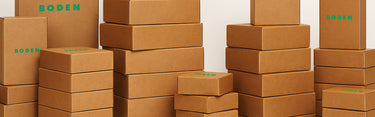
We hit our 5-year goal of having over 90% of our packaging made from recycled content, which was a great achievement.
We also continued our journey to remove and reduce the amount of packaging that we use. The major change in the year was in August 2025; we stopped putting paper delivery notes in our customer orders. Customers already receive regular emails updating them on the status of their order and have the facility to complete and submit any return paperwork electronically via an online portal. Therefore, it was decided to discontinue these, as it is now widespread practice not to receive printed delivery notes in online orders. The removal of delivery notes will remove over 22k reams of paper, 56 tonnes per annum, which is 16,500 trees. There is also the cost saving, reduction in printers and all the print consumables required.
In the UK we continued to operate our closed loop recycling for cardboard and polythene. Since we started in 2023, we have recycled 139 tonnes of polythene waste, sufficient to make 860K medium dispatch bags (21 weeks usage). On cardboard waste, we have recycled 889 tonnes, which is easily sufficient to cover our annual box usage. The amount of recycled paper would cover the football pitch at Wembley 1225 times or would make 1.91m units of our most used dispatch box (last year’s usage was 175k).
REDUCING LANDFILL
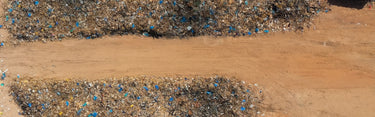
Our aim is to avoid our product or our waste going to landfill. At the heart of what we do is to design and manufacture our products to last. We then look to extend their life with our Care, Repair and Rewear programme. This was launched in 2021 for the UK and in 2023 400 items were sent to us to repair. The oldest item returned to us for repair this year was bought from Boden in 2004. It was a wrap coat. The lining had degraded over time, so we replaced it and sent it back to the customer to carry on wearing.
For end of line stock we work with charities to make sure none of it is sent to landfill and we also run a Pass It On programme for our customers, whereby they can send items back that they no longer want, for an account credit. We then include these in our donations to charities or have the products recycled. We had over 1600 items returned to us by customers in the year.
Last year the focus at our Leicester site was to segregate the general waste by material type prior to collection to reduce the amount sent to landfill. Through better segregation we reduced the amount sent to landfill by 65% (4 tonnes in 2025 v 11.6 in 2024).
Of the waste that we generate across our three sites we either recycle it, send it to be used for power generation or send it to landfill. In 2025 we exceeded our target for over 90% of our waste to have routes that avoid landfill.
For the waste we generated the split was as follows:
- 90% Recycled.
- 7% Diversion (Power generation or other uses)
- 3% to Landfill
We continue to look at ways to reduce our waste across our sites.
REDUCING CARBON
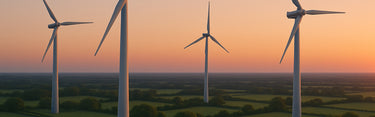
We’re continuing to reduce our Scope 1 and Scope 2 emissions. Our 2024 SECR (Streamlined Energy and Carbon Reporting) submission showed a further reduction in our carbon emissions to 486 tonnes across our four sites, down from 2,400 tonnes in 2019. As in previous years we off-set these emissions by investing in wind farm projects in India using gold accredited schemes, as some of our clothing is made there.
We know there’s a lot more to do. Most of the carbon emissions associated with our business occur in the manufacturing of our clothes by our suppliers (Scope 3). As well as choosing lower-impact fibres we’re developing tools to highlight hot spots of heavy carbon emissions in our supply chain. This is the first step in helping our partners remove carbon from the manufacturing process, to reduce our overall Scope 3 emissions.